
Whole-house water systems are one of those purchases where the marketing can make everything sound simpler than the plumbing. One box promises “soft” water, another promises filtration, a third adds UV, and suddenly you are comparing flow rates, carbon media and hardness chemistry before breakfast.
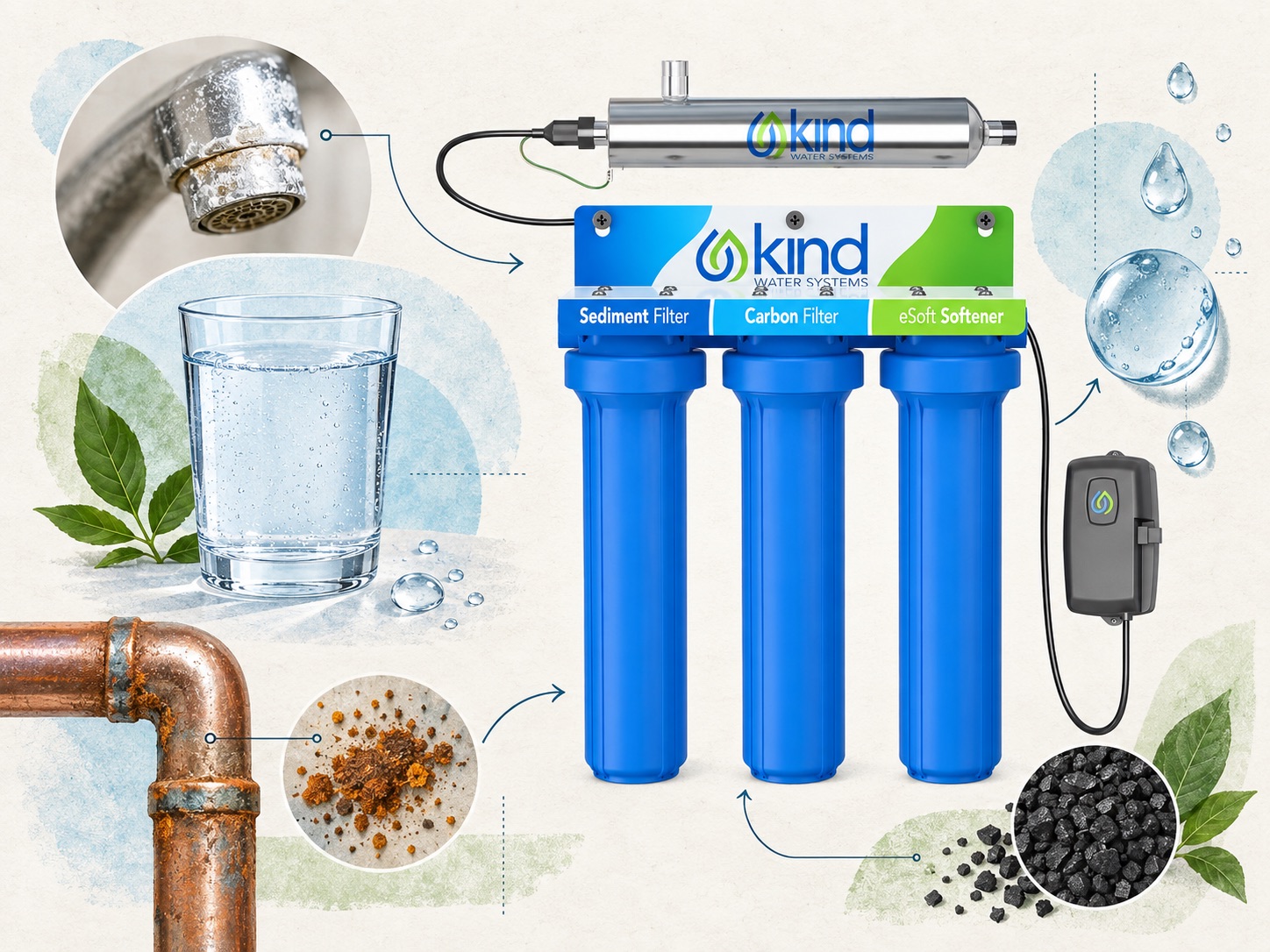
Kind Water Systems tries to simplify that decision with compact systems that combine several stages in one wall-mounted setup. Its best-known city-water model, the E-3000, combines sediment filtration, catalytic carbon and a salt-free scale-control stage. The E-3000UV adds ultraviolet treatment for microorganisms.
The important detail is that Kind’s salt-free stage is not a conventional water softener. It does not remove calcium and magnesium from the water, so a hardness test can still read “hard” after installation. Instead, the company uses template-assisted crystallization (TAC) to reduce the tendency of those minerals to form hard scale. That distinction explains both why some households love the system and why others buy it expecting traditional soft water and come away disappointed.
For this Kind Water review, we checked the current product range, specifications, replacement schedule, warranty terms, installation information and independent customer feedback.
What Is Kind Water Systems?
Kind Water Systems is a US water-treatment brand selling whole-house filtration, salt-free and salt-based softening systems, UV purification, well-water equipment and point-of-use reverse osmosis. The company says its compact municipal systems are built with components made in the US and Italy, while UV chambers and electronics are sourced from Canada.
The current range is split mainly by water source. City-water systems are designed around sediment, chlorine and chemical reduction, scale control and optional UV. Well-water systems add configurations for issues such as iron, sulfur, pH and bacteria.
For most homeowners on treated municipal water, the products worth understanding first are the E-1000 filter, E-2000 salt-free conditioner, E-3000 filter-plus-conditioner and E-3000UV. The E-3000 is the model that best represents what Kind is trying to do: one compact wall-mounted system rather than a row of large tanks.
Kind Water Systems at a Glance
| Model | What It Does | Best For | Current Listed Price* |
|---|---|---|---|
| E-1000 | Sediment + carbon filtration | City water without scale-control needs | $1,000-class system |
| E-2000 | Sediment + salt-free scale control | Homes focused mainly on scale | $1,000-class system |
| E-3000 | Sediment + carbon + salt-free scale control | Most city-water households | $1,884.69 |
| E-3000UV | E-3000 + UV purification | Households wanting added microbial protection | $2,837.63 |
*Prices and promotions can change. We use the live listed price as a snapshot, not as a permanent promise.
How the Kind E-3000 Actually Works
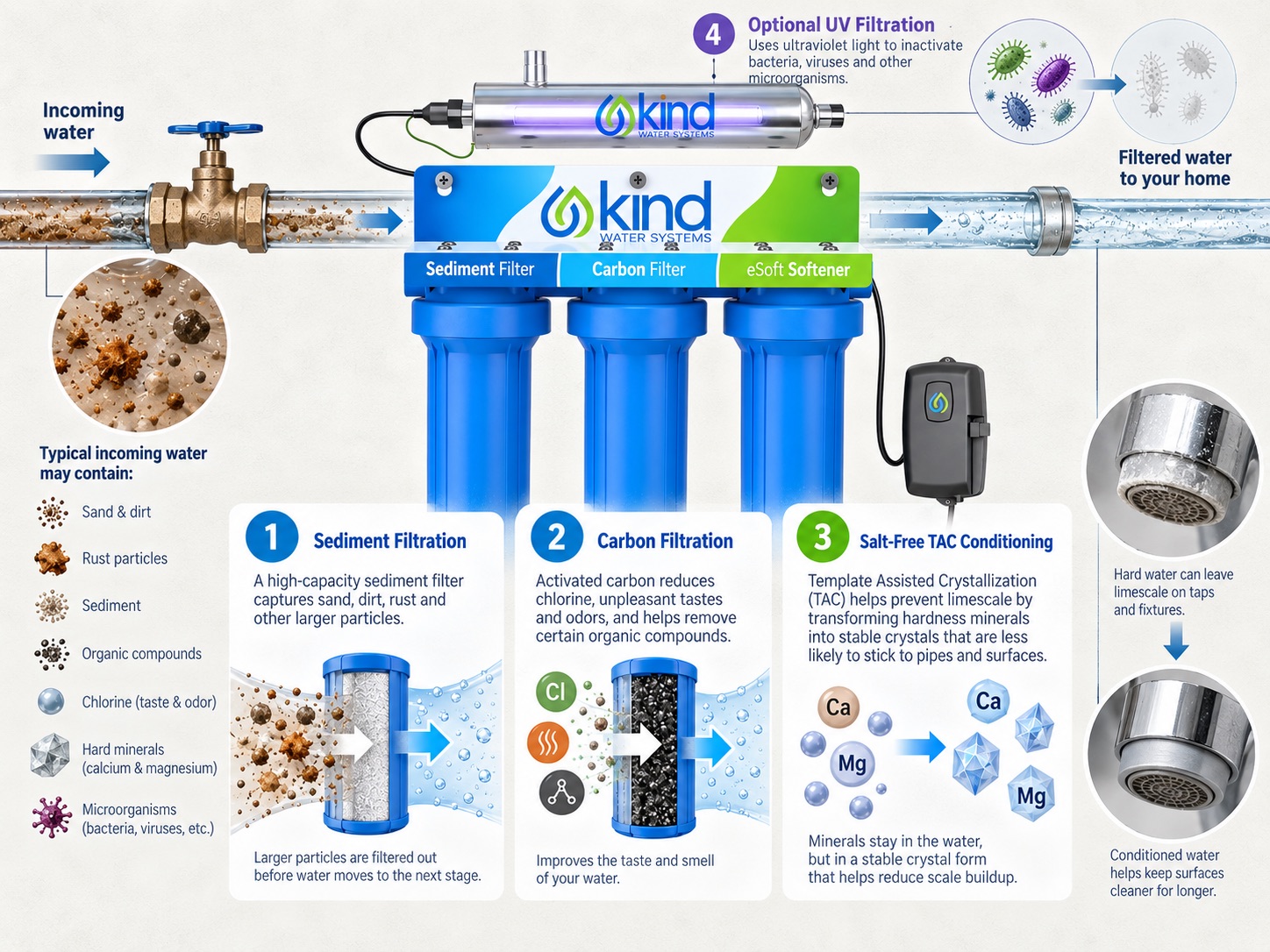
Stage 1: Sediment Filtration
The first cartridge is a 5-micron sediment filter designed to catch dirt, sand, rust and other visible particulates before they reach the carbon stage. That is not the glamorous part of a filtration system, but it matters: sediment can shorten the life of downstream media and restrict flow as a cartridge loads up.
Kind recommends replacing the sediment and carbon filters every 6 to 12 months depending on water quality. In a house with relatively clean municipal water, annual replacement may be realistic; heavy sediment can shorten that interval.
Stage 2: Carbon Block Filtration
The carbon stage is where the E-3000 addresses the issues most city-water users actually notice. Kind says the block targets chlorine, chloramine, VOCs, pesticides and other chemical contaminants. In practical terms, the most obvious changes are likely to be taste and odor, especially in areas where tap water carries a strong disinfectant smell.
This is also the part of the system that makes the E-3000 more than a scale-control device. A conventional softener is excellent at removing hardness minerals, but it is not designed to be a broad chemical filter. Kind combines those jobs rather than treating them as the same thing.
Stage 3: ESOFT TAC Scale Control
This is the stage that needs the most explanation. Kind’s ESOFT media uses template-assisted crystallization. Instead of exchanging calcium and magnesium ions for sodium, as a salt-based softener does, TAC encourages hardness minerals to form microscopic crystals that are less likely to attach to pipes, heating elements and other surfaces as hard scale.
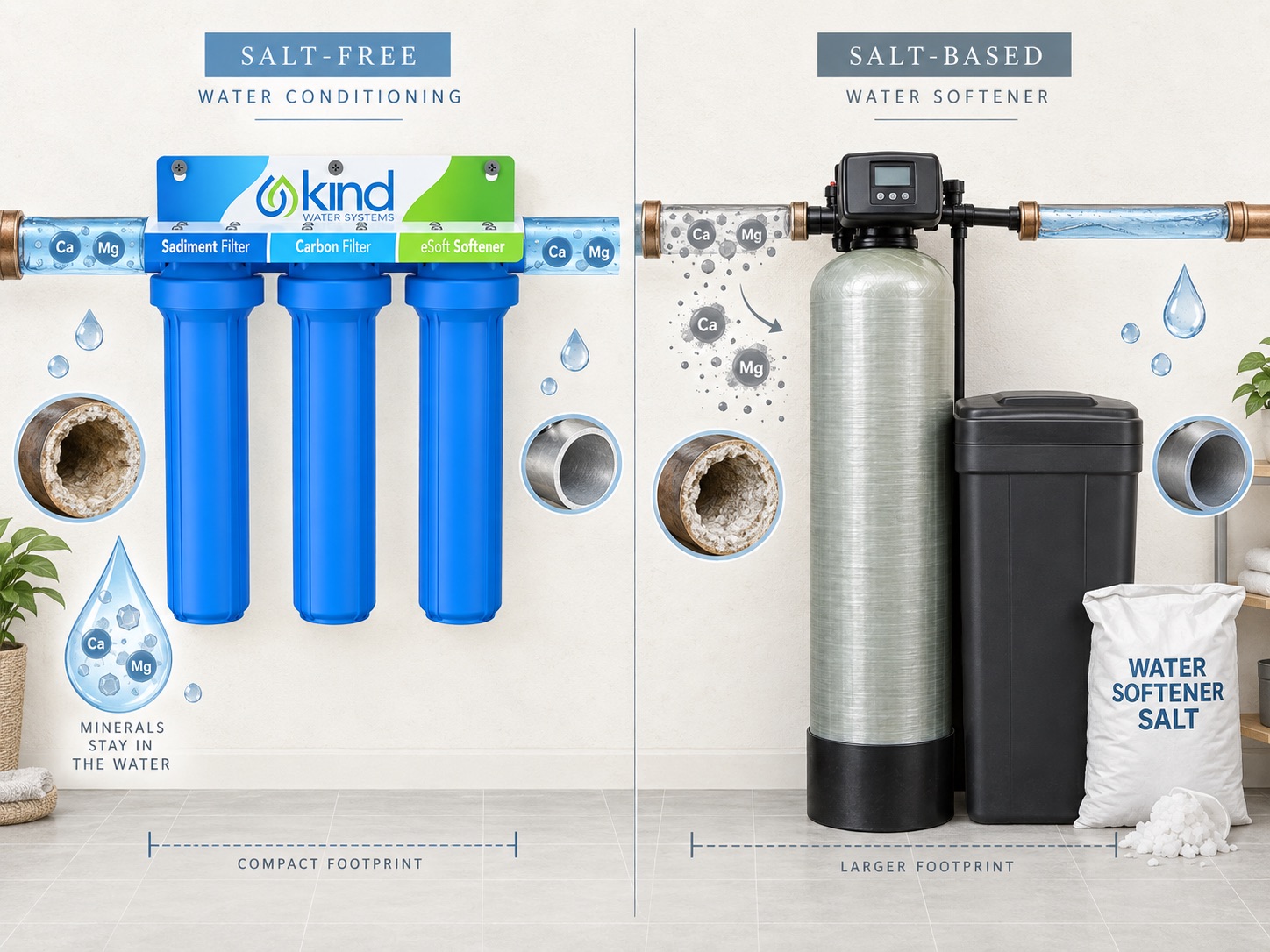
That means the minerals remain in the water. If you use a hardness test strip before and after installation, the number may barely move. That is normal for a salt-free conditioner. It also means you may still see mineral residue where water evaporates, particularly on dark fixtures, shower glass or a coffee maker.
Kind currently describes the E-3000 as reducing scale buildup rather than removing hardness, and that wording is the one we would use. If your goal is protecting plumbing and appliances without hauling salt bags or producing brine wastewater, TAC is attractive. If your goal is genuinely low-hardness water, a slippery “soft water” feel and the strongest reduction in spotting, a conventional ion-exchange softener is the better technology.
Does the E-3000UV Make Sense?
The E-3000UV takes the same three stages and adds an ultraviolet chamber. Kind says the UV system sterilizes 99.9% of bacteria and viruses. UV is different from filtration: it does not physically remove organisms from the water, but exposes them to ultraviolet light so they can no longer reproduce.
For a normal municipal supply that is already disinfected and regularly monitored, UV may be more of an extra layer than an essential purchase. It becomes easier to justify if your household has a specific reason to want microbial treatment, if local conditions make you cautious about contamination events, or if you simply prefer redundancy.
UV also adds maintenance. The lamp is a consumable component and should be replaced on schedule, generally annually, while the quartz sleeve needs to remain clean enough for UV light to pass through effectively. Kind’s warranty terms also place water-quality and installation conditions on UV coverage, so this is not a device to bolt on and forget forever.
Flow Rate, Size and Installation
Kind rates the E-3000 for up to 15 gallons per minute and says it is suitable for the large majority of US homes, including homes with up to five bathrooms. That sounds generous, but flow rate should always be compared with how your household actually uses water. A shower, dishwasher and washing machine running at the same time is a different load from one bathroom at a time.
The physical design is one of the system’s strongest points. The compact cartridges mount on the wall rather than occupying the floor space of a traditional softener tank and brine tank. For a garage, utility room or mechanical closet where every square foot is already doing three jobs, that can be a meaningful advantage.
Kind advertises a DIY-friendly installation window of roughly two to four hours. We would treat that as realistic only for someone who is already comfortable cutting and joining their home’s main water line, installing a bypass and checking for leaks under pressure. Several customer reports describe successful self-installs, but installation difficulty is also one of the recurring complaints.
If your plumbing experience ends at replacing a faucet cartridge, hiring a plumber is not an admission of defeat. A whole-house system sits on the main supply. A small leak there is a much less entertaining weekend project than a dripping bathroom tap.
What Customer Feedback Tells Us
Independent feedback is useful here because the same themes repeat on both sides. Positive owners often mention a noticeable reduction in chlorine odor, better-tasting tap water, a compact footprint and relief from maintaining a salt tank. Some also report less scale accumulation over time and easier cleanup around fixtures.
The negative reviews are just as informative. A recurring complaint is that the water still tests hard or that mineral spots remain. Technically, that is not surprising: TAC does not remove hardness minerals. One long-term owner described the filtration as acceptable but was disappointed that the salt-free stage did not eliminate fixture scale; Kind’s own response clarified that the system is intended to alter scale behavior rather than change the water’s mineral composition.
That is why we would not judge the E-3000 by the same standard as an ion-exchange softener. If the buying goal is “my hardness number should drop dramatically,” this is the wrong system. If the goal is “I want chlorine and sediment filtration plus lower scale potential without salt,” it is much closer to the brief.
A recent discussion on Reddit is broadly consistent with that picture. One long-term user praised the compact design, flow rate, filter life and improvement in taste, while another owner liked the filter/conditioner/UV combination but said the DIY installation was more troublesome than expected. That mix feels believable: the hardware can be straightforward in concept without every home’s plumbing being straightforward in practice.
You can read the Kind Water discussion on Reddit if you want the full owner conversation rather than a polished testimonial page.
Maintenance and Ongoing Cost
The E-3000 does not need salt refills, regeneration cycles or a brine tank. Its regular maintenance is mostly cartridge replacement. Kind’s current replacement set for the sediment and carbon stages is listed at $124.22 before any subscription discount, and the company recommends replacement at least every 6 to 12 months depending on water quality.
The TAC cartridge is not treated like an annual disposable filter in the same way, which is part of the low-maintenance appeal. UV owners should budget for lamp maintenance as well.
Over a decade, those consumables still matter. “No salt” should not be interpreted as “no running cost.” The better comparison is between predictable filter replacement and the combination of salt, water used during regeneration, electricity and maintenance required by a traditional softener.
Warranty, Returns and Support
Kind currently advertises a 120-day satisfaction guarantee on its systems. Its compact municipal systems, including the E-3000 family, are covered by a limited lifetime warranty against manufacturer defects. UV components have separate coverage periods: the stainless-steel chamber carries longer coverage than the controller, lamp and quartz sleeve.
The fine print matters. Kind’s warranty excludes problems caused by improper installation, freezing, operation outside specified conditions and use of the wrong system for the water source. The company also states that failure to replace filters according to its maintenance requirements can void warranty coverage.
That is fairly normal for water-treatment equipment, but it reinforces the value of documenting the installation date, keeping filter receipts and testing your water before choosing a system. Buying the most expensive configuration is not useful if it is solving the wrong chemistry.
Kind Water Pros and Cons
What We Like
- The compact wall-mounted design uses far less floor space than a traditional softener and brine tank.
- The E-3000 combines sediment, carbon filtration and scale control in one coherent city-water setup.
- No salt bags, regeneration cycles or brine discharge are required for the salt-free models.
- The 15 GPM design should be sufficient for many multi-bathroom homes when sized and installed correctly.
- Filter maintenance is straightforward and replacement intervals are relatively long.
- The 120-day trial period gives homeowners more room than a short retail return window to decide whether the system suits the house.
What Could Be Better
- Calling TAC a "softener" can create the wrong expectation because hardness minerals remain in the water.
- Households wanting truly soft water, very low spotting and a large hardness reduction may prefer a salt-based system.
- DIY installation is realistic only for homeowners who are already comfortable working on a main water line.
- Replacement filters are an ongoing cost, and UV adds another annual maintenance item.
- The standard whole-house system is not a universal contaminant solution; issues such as fluoride, dissolved solids or specific heavy metals may require different treatment.
Who Is Kind Water Best For?
We think the E-3000 is best suited to a homeowner on municipal water who has a combination of chlorine taste or odor, ordinary sediment and moderate-to-hard water, but does not want the maintenance footprint of a conventional salt softener.
It is particularly appealing in smaller utility spaces, in homes where carrying heavy salt bags is a nuisance, and for people who care more about reducing scale than achieving the classic slippery feel of ion-exchange-softened water.
The E-3000UV makes more sense if microbial treatment is a deliberate requirement rather than an automatic upsell. If your water source is a private well, Kind’s city-water systems should not be your starting point; the company has separate well-water configurations because iron, sulfur, bacteria, acidity and sediment can require different treatment.
We would hesitate if your main complaint is severe hard-water spotting and you want laboratory hardness readings to fall close to zero. That is exactly where a traditional salt-based softener earns its keep.
Kind Water vs a Traditional Salt Softener
| Factor | Kind E-3000 Salt-Free | Traditional Salt Softener |
|---|---|---|
| Removes chlorine/chemicals | Yes, via carbon stage | Usually no, unless paired with filtration |
| Removes calcium/magnesium | No | Yes |
| Reduces scale potential | Yes, via TAC | Yes, by removing hardness |
| Hardness test reading | Usually remains hard | Drops substantially |
| Salt required | No | Yes |
| Brine wastewater | No | Yes |
| Typical water feel | More natural/mineral feel | Classic slick soft-water feel |
| Best fit | Low-maintenance filtration + scale control | Maximum hardness removal |
Final Verdict: Is Kind Water a Good Whole-House System?
Overall rating: 4.4/5
Kind Water makes a convincing whole-house system, but the E-3000 is much easier to recommend once we stop treating “salt-free softener” and “traditional softener” as interchangeable terms.
As a filtration-and-scale-control package, the E-3000 is thoughtfully designed. It tackles sediment and chlorine, fits neatly on a wall, avoids salt and brine, offers strong household flow on paper and keeps routine maintenance relatively simple. The optional UV stage gives buyers a clear upgrade path when microbial treatment is genuinely relevant.
The biggest weakness is expectation management. A homeowner who buys it expecting calcium and magnesium to disappear may conclude that the softener “does nothing,” because a hardness strip can still show the same number and some mineral residue can remain. That is not the same as saying TAC has no value; it means the technology is trying to solve a different problem.
Our take: choose the E-3000 if you want whole-house filtration plus lower scale potential with minimal maintenance. Choose the E-3000UV if you have a sensible reason to add UV. Choose a traditional salt-based softener instead if true hardness removal and the strongest reduction in spotting are non-negotiable.
That is not as tidy as saying one system is universally best, but water treatment rarely works that way. The right setup starts with what is actually in your water, not with whichever blue tank has the most enthusiastic product page.
Frequently Asked Questions
Is Kind Water a legitimate company?
Yes. Kind Water Systems sells a broad current range of whole-house city and well-water systems, replacement parts and reverse-osmosis equipment, with published support, warranty and return information. The company states that Kind Water operates under parent company Purview Solutions LLC.
Does Kind Water actually soften water?
The salt-free E-3000 conditions hardness minerals rather than removing them. Its TAC media is designed to reduce scale formation, but calcium and magnesium remain in the water. If you want those minerals physically removed, look at a salt-based ion-exchange softener.
Will a hardness test show lower numbers after the E-3000?
Usually not by much, because the system does not remove calcium and magnesium. A high hardness reading after installation is therefore not, by itself, proof that the TAC stage has failed.
Does Kind Water remove chlorine?
The E-3000 includes a carbon block designed to reduce chlorine, chloramine and a range of other chemical contaminants. Chlorine taste and odor are among the changes owners most frequently report noticing.
Do I need the UV version?
Not automatically. Municipal water is already disinfected, so UV is an additional layer rather than a universal requirement. It is more relevant when microbial risk is a specific concern or when you want added redundancy.
How often do Kind Water filters need replacing?
Kind currently recommends replacing the sediment and carbon cartridges every 6 to 12 months depending on water quality and system performance. UV lamps also require periodic replacement.
Can I install the E-3000 myself?
Possibly, if you are comfortable working on a home’s main water line and can install the necessary fittings and bypass correctly. Kind markets the system as DIY-friendly, but multiple owners still report that professional plumbing help made the job easier.
Does Kind Water remove fluoride or dissolved solids?
Not with the standard whole-house carbon/TAC setup. Kind says fluoride removal requires a point-of-use reverse-osmosis system. Dissolved solids and specific heavy metals may also require treatment selected for the actual water test results.