
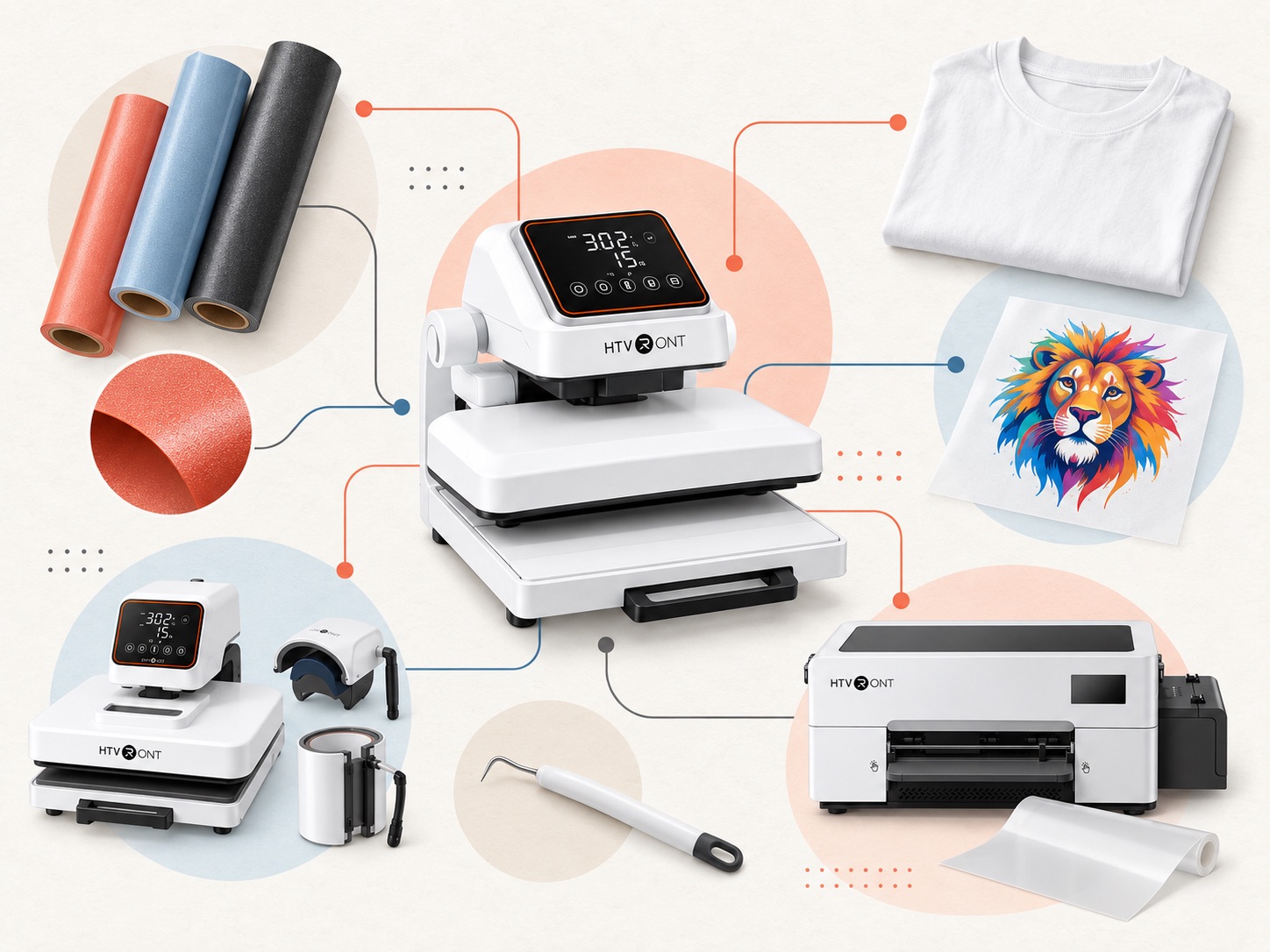
HTVRONT used to be the kind of brand you encountered while looking for an affordable roll of heat-transfer vinyl. In 2026, that description is badly out of date. The catalog now runs from compact mini presses to automated 15-by-15-inch heat presses, dedicated hat and tumbler machines, an all-in-one press, phone-case equipment and several-thousand-dollar DTF printers.
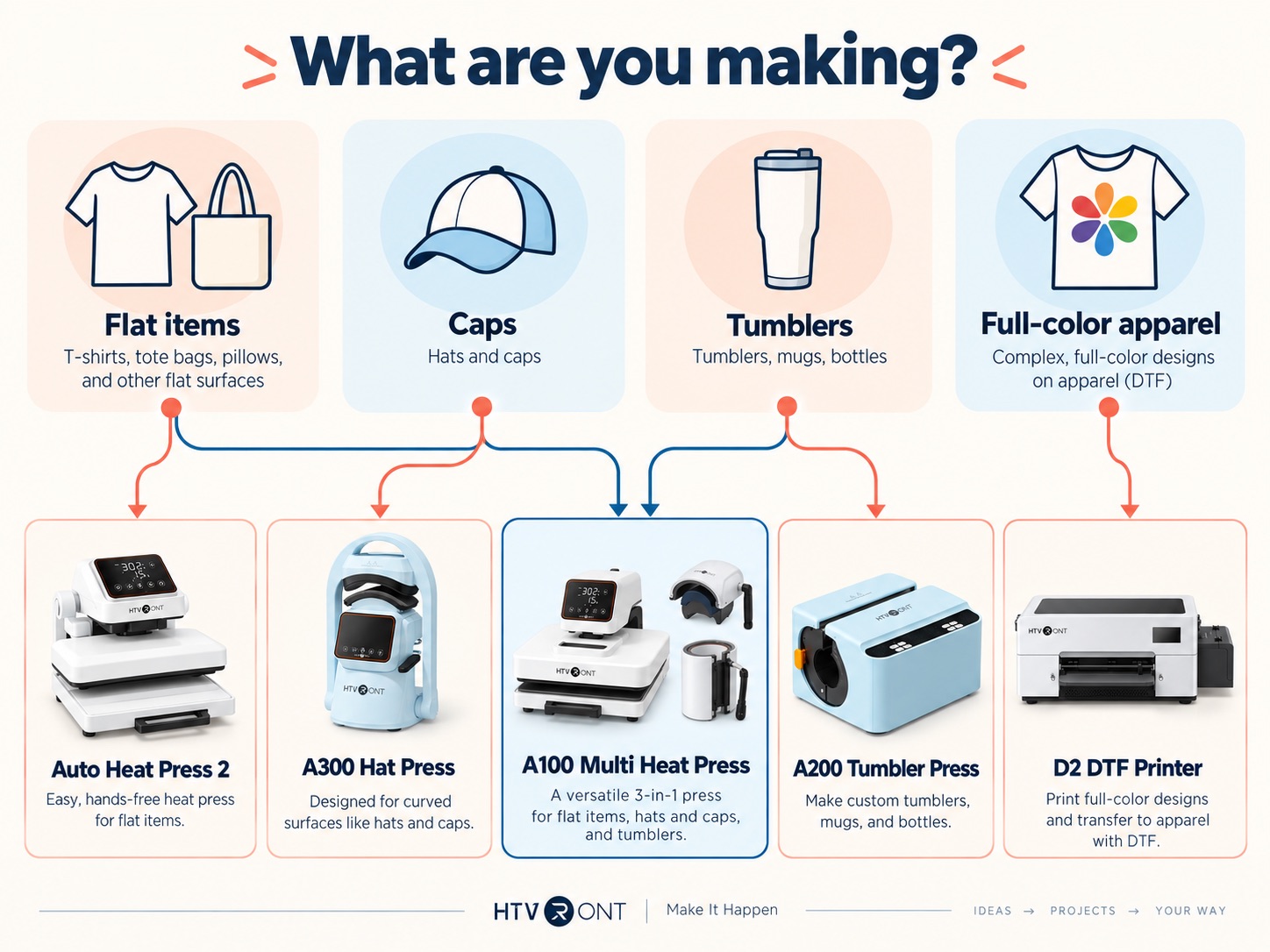
The strongest part of the range is still heat pressing. Machines such as the Auto Heat Press 2 remove much of the repetitive pressure-and-release work from shirts and flat projects, while newer models such as the A100 try to cover several shapes with one base unit. The DTF line is a more serious step into small-business equipment, with higher costs and much more maintenance responsibility.
For this HTVRONT review, we checked the current US product range, specifications, manuals, warranty and return terms, plus independent customer discussions. The result is a brand we find easy to understand at the hobby and prosumer end — and one that deserves more careful due diligence once the equipment starts costing four figures.
What Is HTVRONT?
HTVRONT is a crafting-equipment and materials brand focused heavily on heat transfer. Its store covers heat presses, DTF printers, heat-transfer vinyl, permanent vinyl, sublimation supplies, blanks and tools. The current machine catalog also reaches into embroidery, laser and other maker categories, so HTVRONT is increasingly positioning itself as a broader crafting hardware brand rather than only a vinyl supplier.
HTVRONT’s Main Machines in 2026
| Machine | Main Job | Who It Suits | Current Position |
|---|---|---|---|
| Auto Heat Press 2 | Flat garments, HTV, sublimation, DTF transfers | Frequent hobby use and small-batch apparel | 15 x 15 in automatic press with adjustable pressure |
| A100 Auto Multi Heat Press | Shirts, hats and tumblers with interchangeable heat plates | Creators wanting several press formats in one system | HTVRONT’s 2026 multi-function release |
| A300 Auto Hat Heat Press | Caps and curved hat projects | Hat makers and small personalization shops | Automatic dedicated hat press |
| A200 Auto Tumbler Heat Press | Tumblers and cylindrical blanks | Drinkware-focused crafting | Automatic curved-surface press |
| D2 DTF Printer | Full-color DTF transfer production | Small businesses printing designs in-house | High-cost printer with dedicated consumables and maintenance |
Prices on HTVRONT change frequently through promotions and bundles, so we would treat the live product page — not an old review screenshot — as the price that matters.
Auto Heat Press 2: The Most Straightforward Starting Point
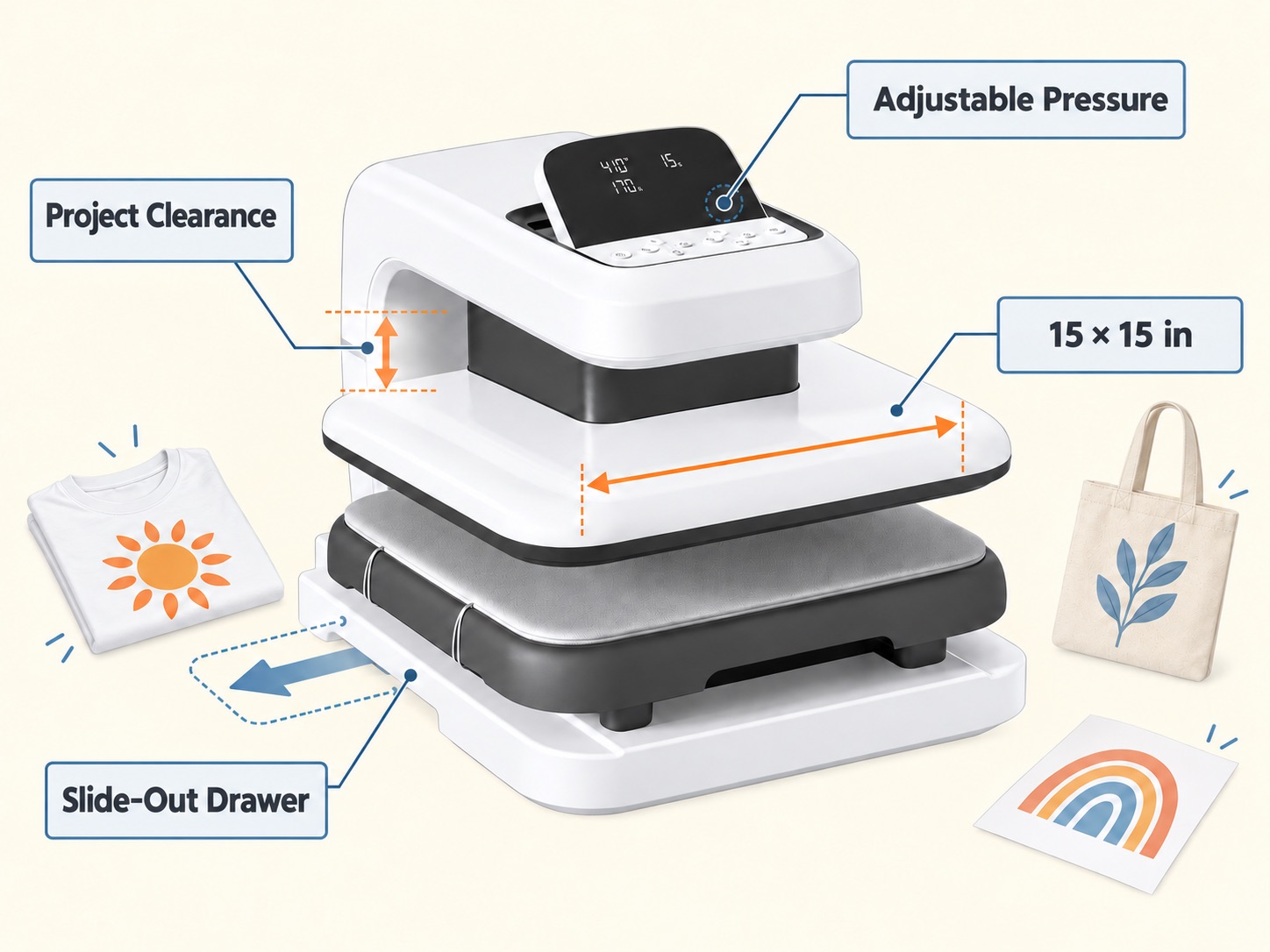
The Auto Heat Press 2 is the easiest HTVRONT machine to recommend as a reference point because its job is clear. It has a 15 x 15-inch platen, automatic pressing, adjustable pressure from 20 to 80 kg, clearance for projects up to 4.5 cm thick, preset and custom modes, and a slide-out work area. HTVRONT also lists compatibility with HTV, sublimation, heat-transfer paper, printable HTV and DTF transfers.
The important upgrade over a basic manual clamshell press is not that the machine somehow understands your project. You still need the right temperature, time, pressure and peel method. What automation changes is repeatability. Once the settings are right, you are not manually pulling a lever with slightly different force on shirt number twelve than you did on shirt number one.
That is useful for batch work and for anyone who dislikes hovering over a hot platen. The slide-out drawer also keeps more of the working area away from the heated upper plate while you align a design. HTVRONT adds automatic release and a shut-off function, which are practical safety features rather than marketing decoration.
A100 Auto Multi Heat Press: One Machine, Several Project Shapes
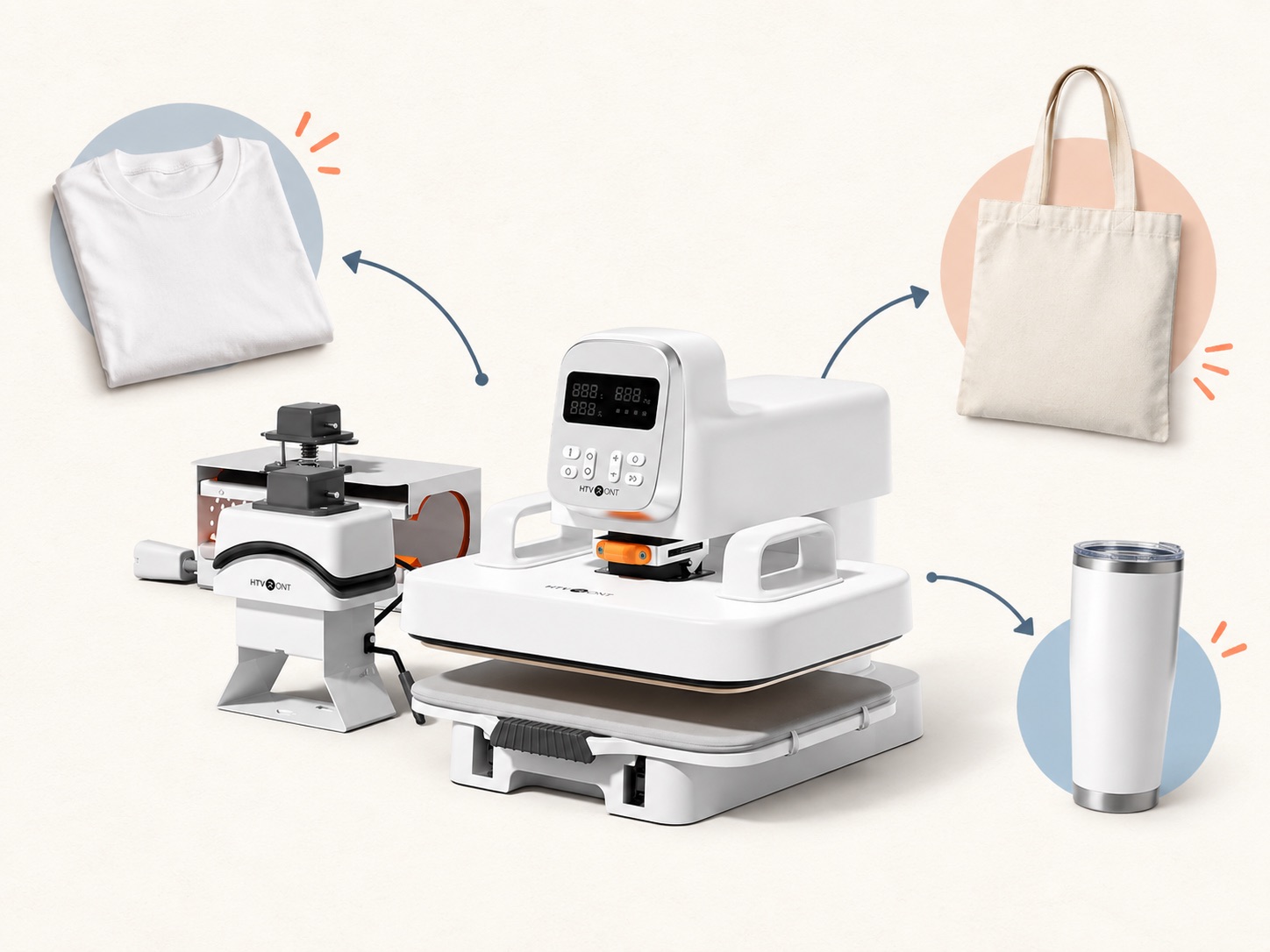
The A100 is the more ambitious idea. HTVRONT calls it its 2026 signature release, and the standard kit combines a 12 x 10-inch flat heat plate, a 20 oz tumbler plate and a large hat plate. Instead of owning separate full machines for every shape, you swap the heating setup around one base system.
The compromise is the same one we see with most multi-tools. A dedicated machine is usually quicker when you repeat one task all day because there is nothing to convert between jobs. The A100 makes more sense for variety than throughput. If ninety percent of your orders are shirts, we would still lean toward a larger dedicated flat press. If your orders change shape constantly, the multi-function design becomes much more persuasive.
The Specialty Presses: Hats, Tumblers and Phone Cases
HTVRONT also sells dedicated equipment where geometry is the problem. A flat T-shirt press is excellent at pressing something flat; it is much less elegant when the blank is a curved cap or cylinder.
The A300 Auto Hat Heat Press uses interchangeable hat platens and automatic movement to hold curved blanks more consistently. HTVRONT currently lists pressure above 176 lb, a 104-410°F temperature range and two hat platen sizes in the standard kit. Those specifications matter because cap seams, curved crowns and different hat sizes make even pressure harder than it is on a shirt.
The A200 Auto Tumbler Heat Press performs the equivalent job for drinkware, while the H17 is aimed at sublimation phone cases. These machines are niche purchases, which is exactly why they can be useful: they solve one awkward shape repeatedly instead of asking one general-purpose press to improvise.
DTF Changes the Scale of the Purchase
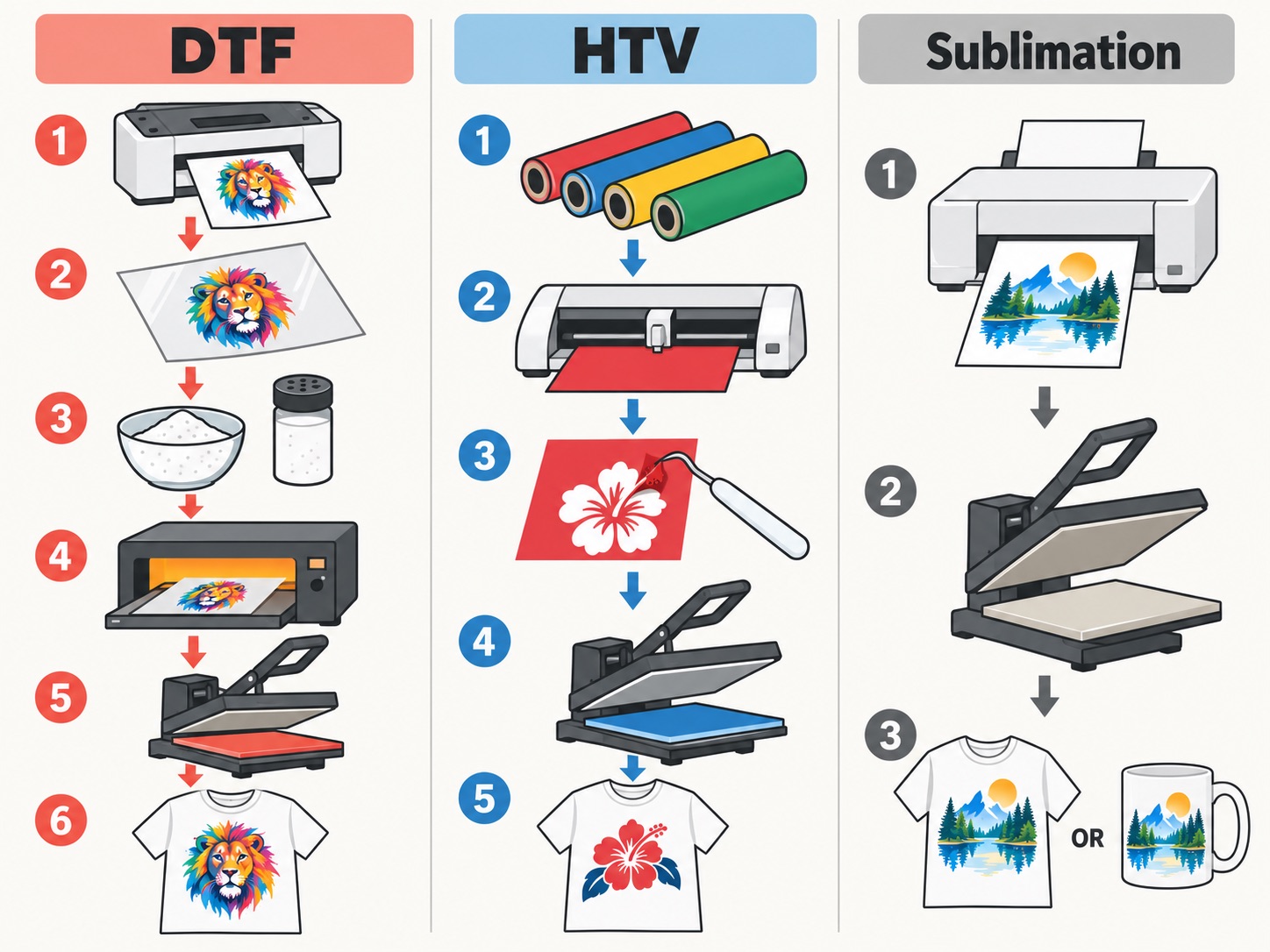
DTF — direct to film — is where HTVRONT stops feeling like a casual craft purchase. The current D2 DTF Printer sits in the multi-thousand-dollar range and is designed around an entire workflow: design software, DTF film, dedicated inks, powder, curing and a final heat press transfer.
The warranty itself shows why the distinction matters. HTVRONT gives machines a 12-month limited warranty, but the DTF printhead and mainboard carry six-month coverage with a one-time replacement provision. The warranty also ties ink-contact component coverage to the use of HTVRONT ink. That is the kind of detail we would understand before buying rather than after a printhead problem.
DTF is attractive because it can produce detailed, full-color transfers for a wide range of fabrics without cutting and weeding each color as separate HTV. The downside is a much more involved production chain and consumable ecosystem. For occasional shirts, it is wildly more machine than you need. For a business sending enough DTF work to an outside printer every week, bringing production in-house can be a more serious calculation.
What About HTVRONT Vinyl and Materials?
Machines get most of the attention now, but HTVRONT still has a large materials catalog. The current HTV collection includes basic polyurethane vinyl plus glitter, puff, patterned, holographic and other specialty finishes, sold as sheets, bundles and rolls. The brand also sells permanent adhesive vinyl, sublimation paper, blanks, mats, heat tape and related tools.
For basic HTV, the pricing is one reason the brand became popular. It is easy to buy a color bundle for experimentation without treating every failed weed as a financial event. Compatibility is broad: HTVRONT says its HTV works with common cutters including Cricut, Silhouette and LOKLiK machines.
Material consistency is the part we would not universalize from one good roll. Independent discussions include plenty of happy repeat buyers, but also complaints about difficult weeding or batches behaving differently. That is common enough across craft materials that we would test a new roll on scrap before running a large batch, especially when the project is for a customer rather than your own laundry basket.
Buying Direct From HTVRONT: Legit, but Read the Policies First
The official HTVRONT store is a legitimate direct-sales channel, and buying there can be attractive because bundles and promotions are often different from marketplace listings. The less exciting part is that return convenience is not necessarily identical to what you may be used to from a large retailer.
The current US return policy says machines can be returned within the stated window, but unused condition matters for non-quality returns, and once a machine has been used, non-defect returns become much more restricted. Customers are generally responsible for return shipping when the reason is not a product-quality issue. That is worth reading before you “just try” a large press on one shirt.
A Reddit discussion specifically about buying direct is reassuring on legitimacy. Several commenters in the US, Canada and Australia reported receiving orders successfully, and some said they would buy direct again because the bundles were better. The original poster still chose Amazon because the retailer’s return convenience mattered more to them. That is a useful way to frame the choice: direct can mean better bundles; a marketplace can sometimes mean easier logistics.
You can read the direct-purchase discussion on Reddit for the full mix of experiences rather than only the comments selected for a brand page.
Returns and Warranty: The Details We Would Save Before Ordering
The official policy pages are clearer than they used to be, but they still reward careful reading. HTVRONT’s FAQ summarizes a 30-day return period and says non-quality returns need to be unused, with customer-paid return shipping. The more detailed return page describes a shorter initial request window in one section, then an extended 30-day window for machines. Because the wording is not perfectly elegant, we would save the live policy page on the day of a large purchase.
The practical rule is simpler: if you are undecided about a machine, do not assume you can complete several projects and then return it because the workflow is not for you. Used machines are generally only returnable for qualifying quality issues. Keep the original packaging, because the policy says missing packaging can complicate a return.
That caution is also reflected in customer feedback, where some Trustpilot reviewers describe smooth support and successful replacements, while others mention shipping or after-sales issues.
Is HTVRONT Beginner-Friendly?
At the heat-press end, yes. Automatic presses reduce the physical steps, the controls are approachable, manuals are available online and the product range gives beginners room to start without immediately buying commercial equipment.
DTF is different. A D2 may be marketed as easier DTF, but “easier DTF” is still DTF: inks, film, powder, curing, cleaning, software and maintenance. We would call that beginner-accessible for someone intentionally starting a printing workflow, not beginner-simple for somebody who wants to make three birthday shirts.
HTVRONT Pros and Cons
What We Like
- Broad heat-press range, from compact hobby tools to automatic 15 x 15-inch machines and specialty presses.
- Auto Heat Press 2 adds genuinely useful repeatability through automatic pressing and adjustable pressure.
- A100 is a clever space-saving option for creators who regularly switch between flat, hat and tumbler projects.
- Large materials ecosystem makes it easy to buy HTV, sublimation supplies, blanks and accessories alongside the hardware.
- Current manuals, tutorials and settings guides make the machines less intimidating for new users.
- 12-month machine warranty on official-store purchases provides a defined support window.
What Could Be Better
- Direct-store return terms are stricter once a machine has actually been used, so this is not a risk-free "try it and see" purchase.
- Independent feedback around delivery, materials and after-sales support is mixed.
- Customer support appears less consistent than the hardware itself, particularly when an order needs troubleshooting, replacement or post-purchase help.
- DTF printers are a major cost and maintenance jump from the heat-press side of the brand.
- The catalog is broad enough that beginners can overbuy specialized equipment before they know which projects they will actually repeat.
- Frequent promotions and bundles mean the apparent "regular" value can be difficult to judge from one visit.
Who Should Consider HTVRONT?
HTVRONT makes the strongest case for hobbyists who have moved beyond an iron or tiny press and want repeatable heat-transfer results without jumping to industrial equipment. The Auto Heat Press 2 is the clearest fit for shirts, totes and similar flat projects, while the specialty machines make sense when one curved product category becomes a regular part of your workload.
The A100 is interesting for a mixed-output craft room where space matters more than maximum throughput. We would look at the D2 only when DTF is already part of the business plan and you can justify the consumables, maintenance and capital cost with actual production demand.
Final Verdict: HTVRONT Makes the Most Sense When You Buy for the Workflow
HTVRONT’s appeal in 2026 is not one standout gadget. It is the fact that the brand now covers most of the heat-transfer path from affordable vinyl to automated presses and, at the far end, in-house DTF production.
The Auto Heat Press 2 is the easiest place to see the value: automation removes repetitive pressing steps without pretending that crafting no longer requires technique. The A100 takes a smart approach to limited workspace, and the specialty presses solve genuinely awkward shapes. The DTF line is more ambitious, but it belongs in a different purchasing conversation because the cost and maintenance are much higher.
A little research before ordering is worthwhile, especially when choosing between HTVRONT’s increasingly broad range of machines. But once you match the equipment to the work you actually plan to do, the value proposition is easy to see: practical automation, accessible pricing and enough choice to grow from occasional crafting into regular small-batch production without immediately jumping to industrial equipment.
Frequently Asked Questions
Is HTVRONT legit?
Yes. HTVRONT operates an official online store, publishes manuals, warranty and return policies, and sells a broad range of crafting machines and materials. Reddit users in the direct-purchase discussion we reviewed also reported successful orders from the official site.
Is the HTVRONT Auto Heat Press 2 good for beginners?
It is one of the more beginner-friendly full-size options because pressing and release are automated and pressure can be adjusted. You still need to learn the correct temperature, time, pressure and peel method for each material.
How long is the HTVRONT machine warranty?
The current US warranty page lists a 12-month limited warranty for machines purchased from the official HTVRONT store. Some DTF core components and accessories have different coverage periods.
Can I return an HTVRONT machine after trying it?
Do not assume so for a non-defect return. HTVRONT’s current policy places strong conditions on used machines and says machines that have been used generally are not accepted for non-quality-related returns. Check the live policy before ordering because the detailed wording can change.
Is HTVRONT vinyl compatible with Cricut machines?
HTVRONT says its HTV works with Cricut, Silhouette, LOKLiK and other vinyl cutters. Cutting settings can still vary by material type and machine, so test cuts are sensible.
Should I buy HTVRONT direct or through a marketplace?
Direct ordering can offer different bundles and promotions, while a marketplace may offer shipping or return terms you prefer. Compare the total price and the actual return policy rather than assuming the lowest sticker price is automatically the better deal.